Kamis, 07 Juli 2011

Interesting Facts about Justin Bieber being on the Cover Page of Magazines


At the start of 2011, magazine sales figures proved putting Lady Gaga on the cover of your magazineis a sure-fire way to guarantee blockbuster sales, while featuring Taylor Swift front and center is an almost certain bust. Now that numbers from the February 2011 issue of Vanity Fair starring Justin Bieber are in, we know how the 17-year-old heartthrob ranks amongst pop-star cover models and it is not good -- in fact, for Vanity Fair, the numbers are nearly horrifying. Bieber's issue is going to have the dubious distinction of being the Conde Nast monthly's worst-selling in 12 years.

According to Women's Wear Daily, who cites results from the Audit Bureau of Circulations' Rapid Report (preliminary newsstand sales figures reported by magazines but not yet confirmed by the Bureau), Bieber's VF issue sold 246,000 copies, 28 percent below the magazine's average of 342,000 for the first half of the year. Since editor Graydon Carter took over the magazine in 1992, only two other covers have performed this poorly -- a 1999 Will Smith issue and a 1993 Harrison Ford one.
More shockingly, the Vanity Fair bomb actually wasn't an anomaly. According to WWD, Bieber also appeared on an October 2010 Teen Vogue cover that sold 121,054 issues, 12 percent below the magazine's 2010 average. His April 2010 People cover sold 961,762 copies, 25 percent below the weekly's average, making it the publication's third-worst seller of the year.
"Worst" and "seller" and not words commonly found in stories about megastar Bieber, who has the highest-grossing concert film in U.S. history and the fourth-best-selling albumof 2010 with 2.3 million copies. So what's the blame for the singer's lack of traction at the newsstand?
The answers vary by the publication: Vanity Fair isn't geared toward the teens and tweens who usually snatch up every piece of Bieber memorabilia. The other stories featured on the February 2011 cover include the words "Warren Buffett," "Wikigate," and "The Kennedy Inauguration" -- not exactly kiddy catnip. Scans of the issue likely hit the web as soon as the first Belieber got his or her hands on it, proving that the story itself wasn't actually all that revealing. Bieber talked about loving Michael Jackson and being a regular kid -- the kind of uncontroversial topics he usually tackles.
The Teen Vogue story was likewise not filled with earth-shattering gossip, and the People cover got more attention for its goofy photo than anything else. Bieber's most talked-about magazine cover in recent memory is certainly Rolling Stone's February 2011 profile in which writer Vanessa Grigoriadis tried to quiz the singer on topics like abortion and politics. Sales figures for the Rolling Stone issue have not yet been reported.
In general, Bieber keeps his fans updated on his everyday doings via Twitter, so unless a magazine story includes extra sexy photos or the promise of never-before-heard tales, Justin's followers just don't need to shell out the extra cash. And while he's still a bona fide superstar, there have been a few chinks in Bieber's usually pristine armor recently -- in May he was pelted with eggs while performing in Australia and last month he had a particularly icy cameo on David Letterman's show.
For the record, Lady Gaga is still pretty darn good at selling magazines. Per AdWeek, Vogue's March Lady Gaga cover sold an estimated 445,000, well above the magazine's average of 370,000 for the first five months of 2011. The secret to her newsstand success? Always being ready with a wacky quote and an even wackier outfit.

Source: Yahoo Music

First Ever Synthetic Windpipe Transplant


Surgeons in Sweden have carried out the world's first synthetic organ transplant.
Scientists in London created an artificial windpipe which was then coated in stem cells from the patient.
Crucially, the technique does not need a donor, and there is no risk of the organ being rejected. The surgeons stress a windpipe can also be made within days.
The 36-year-old cancer patient is doing well a month after the operation.
Professor Paolo Macchiarini from Spain led the pioneering surgery, which took place at the Karolinska University Hospital.
In an interview with the BBC, he said he now hopes to use the technique to treat a nine-month-old child in Korea who was born with a malformed windpipe or trachea.
Professor Macchiarini already has 10 other windpipe transplants under his belt - most notably the world's first tissue-engineered tracheal transplant in 2008 on 30-year-old Spanish woman Claudia Costillo - but all required a donor.

Indistinguishable
The key to the latest technique is modelling a structure or scaffold that is an exact replica of the patient's own windpipe, removing the need for a donor organ.
To do this he enlisted the help of UK experts were given 3D scans of the 36-year-old African patient, Andemariam Teklesenbet Beyene. The geology student currently lives in Iceland where he is studying for a PhD.
Using these images, the scientists at University College London were able to craft a perfect copy of Mr Beyene's trachea and two main bronchi out of glass.
They then coated this was then flown to Sweden and soaked in a solution of stem cells taken from the patient's bone marrow.
After two days, the millions of holes in the porous windpipe had been seeded with the patient' own tissue.
Dr Alex Seifalian and his team used this fragile structure to create a replacement for the patient, whose own windpipe was ravaged by an inoperable tumour.
Despite aggressive chemotherapy and radiotherapy, the cancer had grown to the size of a golf ball and was blocking his breathing. Without a transplant he would have died.
During a 12-hour operation Professor Macchiarini removed all of the tumour and the diseased windpipe and replaced it with the tailor-made replica.
The bone marrow cells and lining cells taken from his nose, which were also implanted during the operation, are able to divide and grow, turning the inert windpipe scaffold into an organ indistinguishable from a normal healthy one.
And, importantly, Mr Beyene's body will accept it as its own, meaning he will not need to take the strong anti-rejection drugs that other transplant patients have to.
Professor Macchiarini said this was the real breakthrough.
"Thanks to nanotechnology, this new branch of regenerative medicine, we are now able to produce a custom-made windpipe within two days or one week.
"This is a synthetic windpipe. The beauty of this is you can have it immediately. There is no delay. This technique does not rely on a human donation."
He said many other organs could be repaired or replaced in the same way.
A month on from his operation, Mr Beyene is still looking weak, but well.
Sitting up in his hospital bed, he said: "I was very scared, very scared about the operation. But it was live or die."
He says he is looking forward to getting back to Iceland to finish his studies and then returning to his home in Eritrea where he will be reunited with his wife and young family, and meet his new three-month-old child.
He says he is eternally grateful to the medical team that has saved his life.

Source: BBC News

Selasa, 05 Juli 2011

Interesting Facts about Celebrities Tattoos

Take a look at some of the Interesting Facts about Celebrities Tattoos: 

Jennifer Aniston was recently spotted in NYC showing off her very first tattoo: the name "Norman" on the inside of her right foot. The fresh ink is a tribute to the 42-year-old actress's dog Norman, a Welsh corgi-terrier mix that passed away in May at 15 years old. "Memorial tattoos are a serious and often necessary thing, but Jennifer chose one of the worst places of all time to get it," says "NY Ink's " Ami James. "The foot is consistently being exposed to the elements, naturally exfoliating itself and being exposed to constant friction. Even a good tattoo will not withstand that for much time at all," the expert tattoo artist explains. "Jennifer will be lucky if that tattoo looks decent for even a few months."


The tattoos on Angelina Jolie's upper left arm show the map coordinates for the birthplaces of her children. The tats have been inscribed in the same spot where a tribute to the 36-year-old actress's ex-husband Billy Bob Thornton once lay. His name, along with a Chinese dragon, were surgically removed after the pair divorced in 2003. "Tattoos last a lot longer than most romances," James says. "Thank god for laser."


Newly engaged couple Nikki Reed and Paul McDonald wasted no time getting matching tattoos. After a two-month-long whirlwind romance, the "Twilight" actress and her "American Idol" alum beau inked each others' first names on their respective right-hand ring fingers. "I think when you have thought and effort, added with good taste, even the most simple tattoo concepts can be turned into something really nice," James says of the duo's expression of love.


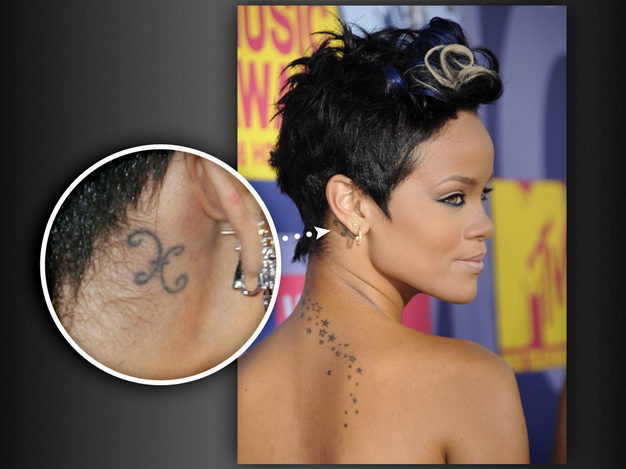
Songstress Rihanna sports a Pisces symbol tattoo behind her right ear. "A fine line runs between a job stopper and something you can pull off in this location. A lot of clients do not take into consideration when they see a trendy tattoo location and how something of this nature can change your future prospects forever. I obviously do not support tattoo prejudice, but that doesn't mean it does not exist," James explains. "With a tattoo like this, something as simple as pushing your hair behind your ears in an interview may lose you a job to competition. Rihanna pulls it off, but then again, I doubt she will be looking for a job anytime soon either."


"Heroes" starlet Hayden Panettiere is often pictured showing off the tattoo she has running down the left side of her back, despite it being misspelled. In full, it reads, "Vivere senza rimipianti," which is meant to be "to live without regrets" in Italian. Unfortunately for the 21-year-old actress, her tattoo reads "rimipianti" instead of "rimpianti," adding an extra "i." "She got the wrong person for the job," James says. "A reputable shop double checks spelling." Although initially horrified about the misspelling, Panettiere says she is proud of her tattoo and wants to "live up to what it means."


How many tattoos does rapper Lil Wayne have? We're betting that Lil Wayne himself isn't able to answer that question. "I seriously doubt Lil Wayne put the thought necessary into any of his tattoos, especially the ones on his face," says James. "He went from very little to being tattooed everywhere in about a year."


Johnny Depp is another celebrity who's a fanatic lover of tattoos, having numerous tats all over his body. From dedications to his children (Jack and Lily-Rose) and ancestral heritage (Cherokee Indian) to even the ink he had altered (Wino Forever) after he broke up with actress Winona Ryder, Depp's tattoos seem to suit him. "Johnny Depp looks like he earned his tattoos with a mug of wine from some old pirates," James observes. "But somehow he still manages to make them look cool."


Pamela Anderson rocks a barbed-wire armband tattoo on her left bicep. James doubts that there's much meaning behind Anderson's tat, saying, "The overly trendy, everyone-has-to-have tattoo began its career as the armband, then it moved to the lower back, and now it is working its way back up again." The tattoo artist advises, "Tattoos should be about individuality, not what's hot, because it may not be for long."

Source: Yahoo TV

Antarctica Tops the List of Coldest Places on Earth

Antarctica takes position number one among the coldest places on earth. Mostly uninhabited except for penguin and seal colonies found along the coast, Antarctica has practically no match on the temperature department. At the Plateau Station, temperatures can easily plummet to -119.23° Fahrenheit (-84° Celsius) and the annual average temperature barely reaches -32.8°F (-36°C). The record as the coldest place, however, goes to Vostok Station, Antarctica, where the temperature reached -129°F (-89.4°C) on 21 July 1983. Scientists are the only humans to live on Antarctica for months at a time, and even they do it only in summer.
Of all inhabited areas, one of the coldest places in the world is Siberia. Although global warming has taken a toll on Siberian winters over the past decade, it's normal for temperatures to reach -60°F (-51.1°C) in January. Oymyakon, in Eastern Siberia, has an average winter temperature of -49°F (−45°C), and may have reached a low of -96.16°F (-71.2°C), although the official record is -90°F (-67.7°C). The little village is home to 900 permanent residents, who endure winter for nine months out of the year, and considered -30°F (−34.4°C) "balmy." The area is so cold that empty plastic bags taken outside will freeze within minutes and then crack like glass.
Outside of Russia, the prize as one of the coldest places goes to Greenland, where the cities of Northice and Eismitte frequently see temperatures of -50°F (-45.5°C). The Yukon, Canada, falls close behind by only a few degrees. In the US, one of the coldest places is definitively International Falls, Minnesota, where temperatures normally reach -32°F (-35.5°C) in winter. Prospect Creek, Alaska, has broken several records in the American continent, including reaching -79.8°F (-62.1°C) in 2003.
To survive in the coldest places in the world, humans have had to adapt their environment and lifestyle significantly. Everything freezes at such low temperatures, from electronics to gasoline to pen ink; batteries lose power and pipes crack under the pressure exerted by ice and snow. In Ojmjakon, children are not allowed to play outside for more than 20 minutes at a time during a typical winter day. At -60°F (-51.1°C), their lungs can freeze and collapse. Despite all the difficulties, humans have found a way to change the environment and survive. Many of the coldest places in the world now attract tourists that are eager to see, at least for a few days, what real winter is all about.

Check out the Video to know the Coldest Places in World:

Antarctica tops the list of coldest places on earth, with one spot recording a bone-chilling -129F. By comparison, the US record of -80 seems downright warm.

Senin, 04 Juli 2011

Cars Used in Filming Transformers 3: Dark of the Moon

 Here is the list of Cars that has been used to film the Movie Transformers 3: Dark of the Moon & Pictures below:

Skids – Chevy Sparks Green  
Blue Mercedes-Benz W212 
Bumblebee – Fifth Generation Chevrolet Camaro 
Dale Earnhardt, Jr NASCAR

Ironhide – GMC Topkick 
Jimmie-Johnson-NASCAR
Juan Pablo Montoya NASCAR 
Megatron – Armored Rusty Mack Titan 10-wheeler Fuel Tank Truck 
Mirage – Red Ferrari 458 Italia 
Mudflap – Chevrolet Sparks Orange 
Optimus Prime – Blue Peterbilt 379 Truck 
Ratchet – Search and Rescue Hummer H2 
Sentinel Prime – Fire Rescue Truck 
Sideswipe – Chevrolet Corvette Stingray 
Soundwave – Silver Mercedes-Benz SLS AMG


Skids – Chevy Sparks Green Transformers 3 Cars 

Blue Mercedes-Benz W212 Transformers 3 Cars

Bumblebee – Fifth Generation Chevrolet Camaro Transformers 3 Cars

Dale Earnhardt, Jr NASCAR Transformers 3 Cars

Ironhide – GMC Topkick Transformers 3 Cars

Jimmie-Johnson-NASCAR-Transformers-3-Cars

Jimmie-Johnson-NASCAR-Transformers-3-Cars

Juan Pablo Montoya NASCAR Transformers 3 Cars

Juan Pablo Montoya NASCAR Transformers 3 Car

Megatron – Armored Rusty Mack Titan 10-wheeler Fuel Tank Truck Transformers 3 Truck

Mirage – Red Ferrari 458 Italia Transformers 3 Car

Mudflap – Chevrolet Sparks Orange Transformers 3 Car

Optimus Prime – Blue Peterbilt 379 Truck Transformers 3 Truck

Ratchet – Search and Rescue Hummer H2 Transformers 3 Car

Sentinel Prime – Fire Rescue Truck Transformers 3 Truck

Sideswipe – Chevrolet Corvette Stingray Transformers 3 Car

Soundwave – Silver Mercedes-Benz SLS AMG Transformers 3 Car
Source: Advance Auto Cars

Minggu, 03 Juli 2011

Interesting Facts about Tom and Jerry


Tom and Jerry is an American series of animated cartoons created by William Hanna and Joseph Barbera for Metro-Goldwyn-Mayer, centering on a never-ending rivalry between Tom the cat and Jerry the mouse.  Hanna and Barbera wrote and directed one hundred and fourteen Tom and Jerry shorts between 1940 and 1957, before the animation department was closed.

The original Tom and Jerry series, now known as one of the most famous and longest-lived rivalries in American TV history, is notable for having won the Academy Award for Animated Short Film seven times, tying with Walt Disney’s Silly Symphonies.  A longtime television favorite with kids, teenagers, and adults alike, in 2000 it was named one of the greatest television shows of all time by Time magazine.

The popular series features on-going comedic fights, usually centering around Tom’s numerous attempts to capture Jerry and the chaos and destruction that would invariably result. Though it’s sometimes unclear why Tom incessantly chases Jerry, Jerry’s eating of Tom’s master’s food (which Tom has been entrusted to safeguard), Jerry’s rescuring of Tom’s other potential dinners (ducks, canaries, and goldfish), and Jerry’s ruining of Tom’s attempts to seduce various feline females seems to be reasons enough.

Central to the Tom and Jerry comic template it that Tom rarely succeeds in catching Jerry, mainly because Jerry is remarkably clever, cunning, and quite lucky. Often seeming to intentionally perpetuate their love-hate relationship, while often extremely annoyed at each another, in many episodes there seems to be genuine friendship (as in “Springtime for Thomas“) and concern for each other’s well-being (as in "Jerry and the Lion,” where Jerry tricks Tom into thinking he has shot him, and Tom comes running with the first aid kit).

Often compared to the Simpsons‘ “Itchy and Scratchy” characters–which many consider an homage to the famous cat/mouse rivals–Tom and Jerry episodes are infamous for some of the most comically gory acts ever committed to the cartoon cell, such as Jerry slicing Tom in half, shutting his head in a window or a door, stuffing Tom’s tail in a waffle iron, plugging his tail into an electric socket, causing a tree to drive him into the ground, sticking matches between his toes and lighting them, and tying him to a firework and setting it off; and Tom retaliating by using everything from axes, firearms, explosives, traps, and poison to try to end Jerry’s life.

While Tom and Jerry has been criticized for being what many consider unnecessarily violent, in reality, there is actually no blood or gore in any of the original cartoons, and neither of the pair are ever seriously injured. (An exception is when Tom gets sliced into pieces in the opening credits of Tom and Jerry: The Movie.) Recurring gags involve Jerry hitting Tom when he’s preoccupied–with Tom only feeling the effects moments later–and Jerry stopping Tom in mid-chase–calling for a time-out–just before he does something terribly nasty to Tom.
Traditionally, music plays a very important part in Tom and Jerry shorts–since Tom and Jerry almost never speak–effectively emphasizing the action, adding emotion to the scenes, and filling in for traditional sound effects.  Most of the dialogue from Tom and Jerry are high-pitched laughs and gasping screams, which are thoughtfully provided via a horn or other musical instrument.  Additionally, musical director Scott Bradley created complex scores that combined elements of popular jazz, classical, and pop music, and often incorporated songs from MGM films like The Wizard of Oz and Meet Me In St. Louis.

Beginning in 1960, MGM had new Tom and Jerry shorts produced in Eastern Europe by Rembrandt Films.  In 1963, however, due to poor quality, production was returned to Hollywood under Chuck Jones’s Sib-Tower 12 Productions, producing forty-seven additional cartoons before it wrapped up production in 1967. The famously popular cat and mouse stars then resurfaced when Hanna-Barbera/Filmation Studios produced cartoons during the 1970s, 1980s, and 1990s, with a feature film, Tom and Jerry: The Movie, released in 1992, and in 2001, their first made-for TV short, “Tom and Jerry: The Mansion Cat for Boomerang.” The most recent Tom and Jerry theatrical short, “The Karate Guard,” debuted in Los Angeles theaters on September 27, 2005.

Today, Time Warner (bought by WTBS founder Ted Turner for his Turner Entertainment division) owns the rights to Tom and Jerry and is distributed by Warner Bros.  In February 2010, the now-classic cartoon celebrated its 70th anniversary with a DVD collection of thirty shorts, and in June 2010 the Tom and Jerry Deluxe Anniversary Collection was released to celebrate the animated duo’s seventh decade together.  The classic episodes are also running on Cartoon Network TBS, TNT, The WB, Boomerang, and Turner Classic Movies.

Source: Factoidz

Haiti cholera outbreak blamed on UN force


Evidence "strongly suggests" that a UN peacekeeping mission brought acholera strain to Haiti that has killed thousands of people, according to a study by a team of epidemiologists and physicians.
The study is the strongest argument yet that newly arrived Nepalese peacekeepers at a base near the town of Mirebalais brought with them the cholera, which spread through the waterways of the Artibonite region and elsewhere in the Caribbean country.
The disease has killed more than 5,500 people and affected more than 363,000 others since it was discovered in October, according to the Haitian government.
"Our findings strongly suggest that contamination of the Artibonite [river] and one of its tributaries downstream from a military camp triggered the epidemic," said the report in the July issue of Emerging Infectious Diseases, a journal of the US Centres for Disease Control and Prevention (CDC).
The article says there is "an exact correlation" in time and place between the arrival of a battalion from an area of Nepal that was experiencing a cholera outbreak and the appearance of the first cases in the Meille river a few days later.
The remoteness of the Meille river in central Haiti and the absence of other factors make it unlikely that the cholera strain could have come to Haiti in any other way, the report says.
Sylvie van den Wildenberg, a spokeswoman for the UN mission in Haiti, would not comment on the findings of the article , referring only to a study released in May by a UN-appointed panel.
That panel's report found that the cholera outbreak was caused by a South Asian strain imported by human activity that contaminated the Meille river where the UN base of the Nepalese peacekeepers is located. The study also found that bad sanitation at the camp would have made contamination of the water system possible.
But the UN report refrained from blaming any single group for the outbreak. While no other potential source of the bacteria itself was named, the report attributed the outbreak to a "confluence of circumstances", including a lack of water infrastructure in Haiti and Haitians' dependence on the river system.
The panel's report was ordered by the UN secretary general, Ban Ki-moon, as anti-UN protests spread in Haiti and mounting circumstantial evidence pointed to the troops.
Before that, for nearly two months after the outbreak last October, the UN, CDC and World Health Organisation refused to investigate the origin of the cholera, saying that it was more important to treat patients than to try to figure out the source.
The article comes as health workers in Haiti wrestle with a spike in the number of cholera cases brought on by several weeks of rainfall. The aid group Oxfam said earlier this month that its workers were treating more than 300 new cases a day, more than three times what they saw when the disease peaked.
Cholera is caused by a bacteria that produces severe diarrhoea and is contracted by eating or drinking contaminated food or water.
The disease has spread to the neighbouring Dominican Republic, where more than 36 deaths have been reported since November.
Epidemiologist Renaud Piarroux, the lead author of the CDC journal article, was initially sent by the French government in late 2010 to investigate the origins of Haiti's outbreak. He wrote a report for UN and Haitian officials that said the Nepalese peacekeepers were likely to have caused the outbreak.
The latest study was more complete and its methodology was reviewed by a group of scientists.
The new study argues it is important for scientists to determine the origin of cholera outbreaks and how they spread in order to eliminate "accidentally imported disease".
Moreover, the study says, figuring out the source of a cholera epidemic would help health workers better treat and prevent cholera by minimising the "distrust associated with the widespread suspicions of a cover-up of a deliberate importation of cholera".
It also argues that demonstrating an imported origin would compel "international organisations to reappraise their procedures".
After cholera surfaced last fall, many Haitians believed the Nepalese peacekeepers were to blame, straining relations between the population and UN personnel and sparking angry protests. On the streets, cholera has become slang for something that must be banished from Haiti.
The new study is acknowledged in a commentary by a pair of public health experts affiliated with the CDC.
"However it occurred, there is little doubt that the organism was introduced to Haiti by a traveller from abroad, and this fact raises important public health considerations," wrote Scott Dowell, director of the CDC's division of global disease detection and emergency response, and Christopher Braden, a medical epidemiologist with the CDC.