Minggu, 01 Mei 2011

Most Beautiful Churches in the World

Beautiful Churches Around the World
Whether or not you're religious, there's no denying that churches are among man's most spectacular creations. From a modern glass-and-pine place of worship deep in the Arkansas countryside to a wooden stave church dating back to the Middle Ages in Norway, we scoured the globe to identify the most breathtaking churches in the world.


Borgund Stave Church

Laerdal, Norway


The Borgund Stave Church, in western Norway, dates to 1180.

The interior of the stave church Borgund.

The roof of the stave church Borgund
The country best known for fjords and otherworldly Arctic landscapes is also the only place in Northern Europe with Middle Ages–era wooden churches that are still intact. Norway has 28 in all—each attractive in its own right—but the loveliest of them is the Borgund Stave Church in western Norway, which dates to 1180. Named for the vertical wooden boards (called staves) from which they are built, stave churches are famous for their nail-less construction of interlocking notches and grooves. The result often looks like an upside down Viking ship. The Borgund is a wonderful example of stave architecture, with four carved dragonheads sprouting from its rooftop gables—like something you'd see in the Far East—and steeply pitched rooftops that mirror the dramatic plunges of the surrounding mountains. Apart from a row of benches, a simple altar, and a cupboard for storing religious vessels, there's not much to see inside the church, but the fantastical exterior is well worth a look.

How to go: Laerdal is 183 miles—and an easy four-hour drive—northwest of Oslo, Norway's capital city. There is an entry fee of 70 Norwegian kroners (about $13) for adults.

Church of Hallgrímur

Reykjavík, Iceland

The Leifur Eirksson monument and the iconic Church of Hallgrímur, in Reykjavík

A close-up view of the architecture of the Church of Hallgrímur

view of Reykjavík from the tower of the Church of Hallgrímur
No matter where you are in Iceland's capital city, chances are you'll be able to spot the towering steeple of this most unusual concrete structure. At 244 feet tall, the Church of Hallgrímur—or Hallgrímskirkja, as locals call it—is the tallest building in Reykjavík and the largest church in all of Iceland. Viewed head on, Hallgrímur resembles a jagged arrowhead or spaceship, erupting from the ground. The design is meant to conjure the rugged mountains, volcanic basalt, and glacial landscapes of Iceland's supernatural scenery. Hallgrímur was under construction for over 30 years and finally completed in 1974, inspiring much controversy along the way thanks to its radical form. And while the architect, Guðjón Samúelsson, did not live to see the church's completion, he'd surely be honored by its presence on nearly every Reykjavík postcard. For a small fee, you can ride an elevator up into the steeple for fabulous views across the capital and out to the Atlantic (rides are 500 Icelandic króna—or about $4.40—per person). The minimalist interior is in keeping with the church's Lutheran heritage, save for one bold element: an enormous organ with some 5,000 pipes that tower up to 50 feet high.

How to go: Hallgrímur is centrally located downtown in Reykjavík. There is a suggested donation of 50 kr (about 44¢) for entry.

La Sagrada Família
Barcelona, Spain
La Sagrada Família, in Barcelona, Spain, is still under construction-an ongoing masterpiece

A closer look at one of the façades of La Sagrada Família in Barcelona, Spain
This gorgeously macabre Gothic cathedral, designed in the 1880s by celebrated Spanish architect Antoni Gaudí, is Barcelona's most famous tourist site. La Sagrada Família is constructed of stones and rocks, and the jumbled way they're pieced together resembles a melting house of wax or mineral deposits inside a psychedelic, stalagmite-rich cave. Situated at the end of a bustling city street lined with cafés and shops, the towering cathedral appears to have been plucked from a fantasy animation flick, with its cavern-like nooks and crannies, decorated with gargoyles and monsters and columns that completely ignore the right-angle-to-the-floor norm. Gaudí worked on the project for some 40 years but died before construction was completed. He's buried in a crypt beneath the nave. It's easy to imagine the eccentric artist overseeing the ongoing work of his masterpiece. Construction on the cathedral, including the east-facing main face, is scheduled to continue for another 20 to 30 years.

How to go: La Sagrada Família is located in the Barcelona neighborhood of Eixample, in the center of city. There is an entry fee of €12.50 (about $18) per person.

Saint Michel d'Aiguilhe Chapel

Aiguilhe, near Le Puy-en-Velay, France

The Saint Michel d'Aiguilhe Chapel, in rural France, sits atop a 269-foot-high volcanic peak

The Saint Michel d'Aiguilhe Chapel, in rural France

To reach the Saint Michel d'Aiguilhe Chapel, visitors must ascend 268 stone steps carved into the church's needle-like rocky mount
The approach to this sky-grazing church is as breathtaking as the views from the top. To reach Saint Michel d'Aiguilhe Chapel, which is set atop a 269-foot-high volcanic peak near the village of Le Puy-en-Velay in Auvergne, France, visitors must walk up 268 stone steps carved into the church's needle-like rocky mount. The odd geological formation is actually a basalt volcanic plug, formed when lava hardens inside the vent of an active volcano. Thanks to its sheer geological curiosity, the site was considered sacred long before the church was built in 962 A.D. The climb to the top is well worth it: The church is a Medieval classic, its façade dominated by multicolor stonework and Islamic-influenced tiled mosaics. While fairly plain, the interior is interesting, too, and noteworthy for its uneven flooring (due to the nature of its rocky foundation), frescoes, and cave-like atmosphere. Legend has it that Joan of Arc's mother made a pilgrimage here in the early 15th century to pray for her daughter.
How to go: Le Puy-en-Velay is in south-central France, a four-and-a-half-hour train ride from Paris on France's national train line (prices vary). Admission is €3 (about $4.30) per person

Duomo di Milano
Milan, Italy
Duomo di Milano, in Milan, Italy, viewed from the Piazza del Duomo

A view from the top of Duomo di Milano, in Milan, Italy, overlooking the city

An up-close view of the Duomo di Milano, from Piazza del Duomo
Much has been written about the Duomo di Milano—one of the largest Gothic cathedrals in the world—but Mark Twain, perhaps, described the marble church's beauty best, in his 1869 classic The Innocents Abroad: "A very world of solid weight, and yet it seems in the soft moonlight only a fairy delusion of frostwork that might vanish with a breath!" Most of that airy appeal is conveyed in the church's exterior—135 elegant spires and 3,400 intricate statues grace the building. In true Gothic style, the ambience of the interior is rather dark thanks to the stained-glass windows and heavy stone columns. Not to be missed is a schlep up the stairs (or catch a lift up on the elevator) to access the rooftop terraces. Here, surrounded by the cathedral's eerie marble towers, you can see across Milan, all the way out to the peaks of the Alps.

How to go: Set in Milan's city center, the Duomo di Milano has free admission but charges for access to the roof. To ride the elevator, it is €10 (about $14) per person; to climb the stairs is €8 (about $11) per person.

Church of Our Savior on Spilled Blood
Saint Petersburg, Russia
The Church of Our Savior on Spilled Blood, in Saint Petersburg, Russia, is built on the site where Czar Alexander II was assassinated in 1881

A close look at the onion-shaped domes of the Church of Our Savior on Spilled Blood, in Saint Petersburg, Russia

An evening view of the Church of Our Savior on Spilled Blood, in Saint Petersburg, Russia
This onion-domed, rainbow-hued, riverside behemoth in Saint Petersburg isn't quite as famous as its similar-looking cousin, St. Basil's Cathedral, in Moscow—but the Church of Our Savior on Spilled Blood has a much more storied history. It was built on the site where Czar Alexander II was assassinated in 1881. Construction began just a few years later, in 1883, and was funded almost entirely by the imperial family. Then, in the 1930s, the Bolsheviks shuttered it and reportedly used it as a storage facility for potatoes in World War II. The church only reopened in 1997, after 27 years of restoration. Thought to house the world's largest collection of mosaics within a church, the interior is covered from floor to ceiling with intricate tile work depicting biblical scenes. And while no regular services are held here, the site does lure pilgrims of the art variety from the world over who come to stare, slack-jawed, at the more than 75,000 square feet of mosaic marvels.

How to go: The Church of Our Savior on Spilled Blood is in the center of Saint Petersburg, just steps from Nevsky Prospekt, its main thoroughfare. Visitors are charged 200 rubles (about $7) for admission.

Las Lajas Sanctuary
Ipiales, Colombia
Las Lajas looms over the rushing muddy waters of the Guaitara River, in Colombia

A closer look at Las Lajas, in rural Colombia

 Las Lajas Sanctuary sits at the end of a bridge that stretches over a dramatic gorge, deep in the mountains of southwestern Colombia

Deep in the mountains of southwestern Colombia, this church sits at the end of a bridge that stretches over a dramatic gorge—cloaked in lush trees and the occasional veil of a waterfall—over the rushing muddy waters of the Guaitara River. Its name, Las Lajas, refers to the flat rocks found in the surrounding Andes, with which the church was built, and the stones seem to glow against the backdrop of the steamy mountains. Its precarious placement is no accident—it was built here as a tribute to Mother Mary. In 1754, a woman and her deaf-mute daughter were walking in the area when they got caught in a storm and took shelter in a nearby cave. Sometime that night, the Virgin Mary allegedly revealed herself to the daughter—and she began to speak for the very first time. Soon after, a chapel was erected here to honor her. The Gothic Revival–style Lajas Sanctuary was later built, between 1916 and 1949, to replace the 19th-century chapel. The pilgrims who continue to arrive to this day from Colombia, Ecuador, and beyond often leave behind personal plaques, which you'll see lining the cliff walls, to thank the Virgin for miracles.

How to go: Las Lajas is just outside the small city of Ipiales, near the border of Colombia and Ecuador. From Ipiales, it's best to take a taxi from the city-center bus station to reach the church; expect to pay about $2 for the taxi one way. Admission is free.

Ely Cathedral

Ely, England

You might recognize Ely Cathedral, in England, from several Hollywood films, including 2010's The King's Speech


The sanctuary of the Ely Cathedral

The east end of the Ely Cathedral
You might recognize Ely Cathedral from the big screen. In the 2010 movie The King's Speech, the inside of the cathedral was transformed into the interior of Westminster Abbey to such effect that we awarded the film our own Budget Travel Oscar for inspiring a desire to travel to England. The church has also had cameos in 2008's The Other Boleyn Girl and the 1998 film Elizabeth. The history of the Ely Cathedral is fascinating enough for Hollywood in its own right. The foundations for this spectacular stone church, set amid poppy fields in the countryside outside of Cambridge, were laid by Benedictine monks in the 11th century. But for hundreds of years prior, the site lured religious pilgrims to visit the shrine of Etheldreda, a Saxon princess who left her husband to pursue a religious life. Etheldreda established a monastery here in the 7th century and is said to have planted a staff in the ground that then blossomed into a tree overnight—a miracle that led people to believe she was a saint. For hundreds of years after, pilgrims made their way to a shrine to Etheldreda inside the cathedral; a plaque now marks where the shrine once stood. Today, the church is best known as a shining example of Norman architecture, marking the Romanesque style's arrival in Britain (the cathedral's nave and south transept are considered perfect Norman examples).

How to go: Ely is an hour's train ride north of London (£23.50 or about $38.25). Admission for adults, including a guided ground-floor tour, is about $9.30.

Church of the Assumption

Lake Bled, Slovenia

Lake Bled - Church of the Assumption of Mary
Unless you're a fit swimmer (and don't mind cold water), you'll have to hire a local pletna boat to make the short crossing to the Church of the Assumption, perched on a fairy-tale island in the middle of Lake Bled in northwest Slovenia. The first masonry church on the island was constructed in 1142, though the structure you admire today was built in the 17th century following an earthquake that destroyed the prior incarnation. The popular mountain resort town is surrounded by scenic Alps and has long lured tourists, visiting dignitaries, and world leaders (none other than Marshal Tito had his private retreat here during Yugoslavian times). During the summer months, in particular, a steady stream of lovebirds flock to the island church to say their vows in the idyllic setting (from afar, the church appears to float in the lake). Local tradition dictates that grooms must carry their brides-to-be up the 98 steps from the boat dock to the church—if they fail, locals say, then they aren't yet fit for marriage. To improve your own luck, whether you're married or single, you can follow the locals' lead and ring the church's bell before boarding your boat back to town.

How to go: Lake Bled is a one-hour train ride northwest of Slovenia's capital, Ljubljana (€4.80 or about $6.90). To reach the island church, arrange a pletna ride with the boatmen stationed at both the Health Park and the Rowing Center in town. For about $17 per person, you get a pleasant boat ride and half-hour stop on the island. Church admission is free.

Thorncrown Chapel
Eureka Springs, Arkansas
Thorncrown Chapel, Arkansa
Deep in the Ozark Mountains, near the community of Eureka Springs (one of the coolest small towns in America according to Budget Travel's 2011 poll), lies Thorncrown Chapel. The church is so far off the beaten path that even the best new GPS devices don't quite get the coordinates right—but it's worth seeking out. The stunning pinewood structure seems to be built almost entirely of glass (425 windows stand in for walls), which brilliantly illuminates the interior with natural light and seems to pull the surrounding forest right inside the church. In fact, many call Thorncrown a "forest within a forest." It was built by the Frank Lloyd Wright–trained architect E. Fay Jones in 1980. Jones himself liked to call his creation "Ozark Gothic" because he based the design and use of natural light on the classic Gothic Sainte-Chapelle, in Paris. Still, he seemed to have the Eureka Springs area in mind, as well: Jones used only local pine, and in pieces no larger than what could be carried through the woods by two men, all in an effort to preserve the church's natural setting.


How to go: Thorncrown Chapel is about a mile-and-a-half west of Eureka Springs, on Highway 62 West. As stated, neither GPS nor Google Maps correctly show the chapel's location, but the Thorncrown's website has an accurate map. There is no admission fee.


Japan Tsunami Satellite Pictures, Before & After

Here you can see some of the pictures of the Tsunami in Japan before and after.

 Minamisanriku, Japan, in 2002 


 Minamisanriku, Japan, After 2011 Tsunami 

 Soccer Field in Minamisanriku, Japan, in 2002

 Soccer Field in Minamisanriku, After 2011 Tsunami

 Yagawahama, Japan, in 2007 

 Yagawahama, Japan, After the 2011 Tsunami 

 Sendai Airport, Japan, in 2003 

Sendai Airport, Japan, After the 2011 Tsunami

Source and To see more: National Geography

Sports Facts - 15 Athletes Gone Broke (who Lost Everything)

 Athletes Who Lost it All
In 2008, the NBA Players' Association claimed that 60% of pro basketball players go broke within five years of retirement. It’s not hard to see why. In the annals of “easy come, easy go,” few people see it come and go like professional athletes. 
While it’s true that many take their salaries and invest them in sensible and enduring business ventures, many others squander their multimillion-dollar salaries on expensive cars, jewelry and mansions, and when the checks stop coming in, they have little to show for it. 

Latrell Sprewell

 Basketball player Latrell Sprewell first made headlines during his tenure with the Golden State Warriors. During a 1997 practice, he choked his coach, P.J. Carlesimo, and earned a 68-game suspension. Sprewell still went on to a substantial career, earning almost $100 million. 

It all came to an end when he turned down a a three-year contract extension from the Minnesota Timberwolves worth $30 million. According to Sprewell, this was simply not enough money. He said, "I have a family to feed ... [team owner Glen Taylor] better cough up some money. Otherwise, you're going to see these kids in one of those Sally Struthers commercials soon." (Sprewell was referencing ChildFund International commercials, which provided sponsorship to deprived children around the world.) 

The Timberwolves’ upper management, unmoved by his family’s tragic situation, didn’t offer him one more cent, and by the end of the 2005 season, he was unemployed. By 2007, his yacht, “Milwaukee’s Best,” had been repossessed by federal marshals after missed payments and insurance worth over $1 million. In 2008, he defaulted on the mortgage on his Milwaukee home, sending it into foreclosure. His Westchester mansion went into foreclosure two years later.

Lenny Dykstra
 Lenny Dykstra was a three-time All-Star player who graced the rosters of both the New York Mets and the Philadelphia Phillies. Nicknamed “Nails” by fans and seemingly never photographed without a thick wad of chewing tobacco lodged in his jaw, he helped lead the Mets to their 1986 World Series victory. 

After retiring, he embarked on a new life as a financial guru, but by 2009, his free-spending lifestyle had caught up with him, and he was so broke that he sold his World Series ring. He ultimately declared bankruptcy, and in the filing he claimed $50,000 in assets and $50 million in liabilities, including money owed to both Bank of America and JPMorgan Chase.


Mike Tyson

 For a while, no boxer on earth was as feared as “Iron Mike” Tyson. The powerful puncher won his first 19 professional fights by knockout, some of which took place during the first round. He quickly became the heavyweight champion of the world, but in 1992 he was convicted of sexual assault and served three years in prison. When he got out, no amount of comeback matches could get him back his mojo, and after biting off a piece of Evander Holyfield’s ear during a 1997 fight, Tyson was disqualified. He never again won another championship. 

Money shouldn’t have been a problem for Tyson. After all, according to the New York Times, he had earned more than $400 million in his boxing career. However, he had spent almost all of it, frittering it away on extravagances like mansions, luxury cars and pet tigers. He also owed $9 million for his divorce settlement and $13 million to the IRS. When he filed for bankruptcy in 2003, he claimed debts of $27 million.

Kenny Anderson
 Kenny Anderson earned an estimated $60 million during his NBA career after playing for nine different teams. He was married three times, and the divorce from his first wife, Tami Akbar, had cost him dearly. She successfully challenged their prenuptial agreement and walked away with half his assets and $8,500 a month in child support. To celebrate her court victory, she had a custom license plate made that read “HISCASH.” 

In addition to monthly child support and alimony payments to Akbar, Anderson was also supporting six other children and two other ex-wives, as well as making monthly payments on his mother’s house. He also owned eight cars and an estate in Beverly Hills, and gave himself a $10,000-a-month allowance that he referred to as “hanging out money”. At the time of his bankruptcy filing, he had $41,000 in monthly expenses to pay.

Michael Vick
 Philadelphia Eagles quarterback Michael Vick is almost as well known for his activities off the field as he is for his achievements on the it. Prior to joining the Eagles, he played for the Atlanta Falcons, who had signed him to a record $62 million six-year contract, as well as a $3 million signing bonus. Then, three years later, he signed a ten-year extension worth $130 million, making him the highest-paid player in the NFL. 

Everything seemed to be smooth sailing for Michael Vick until he went to prison for his participation in an illegal interstate dog fighting ring in 2007. The prison sentence sidelined him for almost two years, and during that time he lost his regular NFL salary and all of his endorsements, including a lucrative Nike sponsorship. The lack of income, combined with his own financial mismanagement, forced Vick to declare bankruptcy from federal prison.

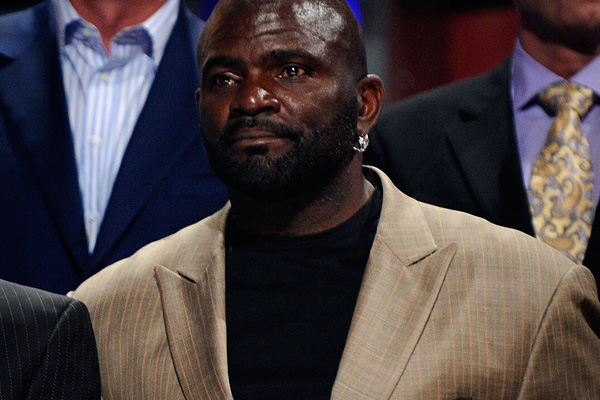
Lawrence Taylor
 Lawrence “L.T.” Taylor is considered one of the all-time NFL greats. The former New York Giants linebacker was drafted in 1981 and began winning awards almost immediately, including three Defensive Player of the Year awards and a 1986 Most Valuable Player award. He was also part of the "Big Blue Wrecking Crew," the formidable Giants defense that made their Super Bowl victories possible. 

Taylor filed for bankruptcy in 1998, literally to keep a roof over his head. According to the Daily News, Taylor was a full year behind on his mortgage payments at the time of the filing. However, his record on the field always spoke for itself, and his financial woes didn’t stop him from being inducted into the Pro Football Hall of Fame in 1999, just one year after declaring bankruptcy. His personal troubles didn’t end there, however, with a traffic-related arrest in 2009 and statutory rape charges during a 2010 trial. He was sentenced to six years probation and had to register as a level one sex offender in 2011.

Johnny Unitas
 In the annals of NFL history, Johnny Unitas is as legendary a player as there is. Nicknamed “The Golden Arm,” his career spanned three decades and saw him set record after record, winning the Most Valuable Player award three times and throwing touchdown passes in 47 consecutive games, a record which still stands today. Off the field, however, it was another story. 

The legendary quarterback had attempted to parlay his earnings into shrewd business moves, such as restaurants, real estate ventures and bowling alleys, but these endeavors never performed in the way that he had hoped. Ultimately, he declared bankruptcy in 1991, and when he died in 2002, Unitas Management Corp was also forced to file for bankruptcy to protect itself from an unresolved lawsuit plaguing the Hall of Famer’s estate.

Dorothy Hamill
 In 1976, Dorothy Hamill won the Olympic gold medal for women’s figure skating, becoming America’s sweetheart and pitch woman for Short n’ Sassy shampoo in the process. Now a superstar, she followed her victory by headlining the Ice Capades from 1977 to 1984, and later bought the company in 1993 in the hopes of reviving interest in the sport. 

Sadly, she could not compete with the ruthless commercial juggernaut that was Disney’s World on Ice, and she sold the company to Pat Robertson's International Family Entertainment, Inc. in 1995. The failed venture took its toll, and in 1996 the skater had to file for bankruptcy. After treatment for breast cancer in 2008, she got back on her feet, and recently she served as a mentor to 2010 Olympic competitor Rachael Flatt. She also continues to skate semi-professionally.

Jack Clark
 Jack Clark played for several baseball teams between 1975 and 1992. Also known as “Jack the Ripper,” he played for the San Francisco Giants, the St. Louis Cardinals, the New York Yankees, the San Diego Padres and the Boston Red Sox. However, in 1992, during his second year with the Sox, he declared bankruptcy, listing debts of almost $7 million, including $400,000 in Federal and state taxes. 

When Clark listed his assets in the filing, he cited 18 luxury cars, including a Ferrari, a Rolls Royce and a Mercedes Benz. He owed money on all but one of them. Apparently, Clark quickly got bored with his collection, and when that happened he would just get rid of the ones he no longer cared for and replace them with new ones. The habit ended up costing him his home, which was worth more than $2 million.

Marion Jones
 Marion Jones started out as one of the most inspiring stories of the 2000 Summer Olympics in Australia. A track and field athlete, she walked away from the competition with three gold medals and two bronze medals, an unprecedented achievement for a female athlete. However, her ex-husband testified under oath that he had seen her inject steroids into her stomach during the games, and she denied the allegations to both the press and to two grand juries. 

Jones eventually confessed to using performance-enhancing drugs in 2007, and it cost her dearly. Not only was she forced to forfeit all of the medals she had won in Sydney, but she was also sentenced to six months in prison. Just a few years earlier, she had earned as much as $80,000 per race, as well as $1 million in endorsements. But now her finances were decimated by legal expenses, and not only was her $2.5 million home in North Carolina foreclosed, but she was forced to sell her mother’s house as well.

Derrick Coleman
 When the New Jersey Nets picked Derrick Coleman in the 1990 NBA draft, it seemed like a solid choice. He had been compared to no less a player than Charles Barkley, and it was assumed that he would turn in a similar performance on the court. However, it was not to be. Aside from being frequently injured and missing many games as a result, he also showed a tendency to gain weight and abuse alcohol. Many sportswriters accused Coleman of simply phoning in his performance. 

Whatever his shortcomings may have been, Coleman earned over $87 million in his 15-year career, so many people were surprised when he filed for chapter 7 bankruptcy in March 2010. In the filing documents, he listed $1 million in assets, including a Bentley, five fur coats and $3,000 worth of jewelry. His debts totaled more than $4 million, which he owed to almost 100 creditors, including American Express, Verizon and even Detroit Mayor Dave Bing.

Mark Brunell
 Quarterback Mark Brunell has played for the New York Jets, the Green Bay Packers and the Jacksonville Jaguars. During his career, he is estimated to have earned over $50 million. However, on June 25, 2010, he filed for bankruptcy, listing over $5 million in assets and nearly $25 million in liabilities. 

At issue are multiple lawsuits stemming from failed real estate ventures and business loans from Champion LLC, a company that included fellow Jaguars Todd Fordham and Joel Smeenge. Still, the lawsuit hasn’t hurt his playing career any, and in July 2010, just one month after filing for bankruptcy, Brunell signed a two-year deal to play for the New York Jets.

Scottie Pippen
Scottie Pippen is best remembered for his tenure with the Chicago Bulls. The 2010 Basketball Hall of Fame inductee was there when they won six NBA Championships, and he was there during the 1995-1996 season in which they won 72 games. He is also the only person to win both an NBA championship and an Olympic gold medal in the same year, and he is one of only four players from the Chicago Bulls to have his jersey retired. 

Unfortunately, Pippen’s successes on the court couldn’t stop him from losing career earnings worth $120 million, including over $4 million for a corporate jet that was grounded just months after he bought it. He sued his attorneys for $8 million for failing to monitor the purchase, and he won the lawsuit. However, the jury ruled that Pippen bore plenty of responsibility for the purchase himself, and he was awarded only one quarter of the reward that he sought.

Antoine Walker

 Antoine Walker currently plays for the Idaho Stampede in the NBA’s development league. In a career lasting 15 years with five different NBA teams, he’s collected one NBA championship and reportedly earned  $110 million. 

However, in May 2010, he filed for bankruptcy, claiming assets of $4 million and liabilities of almost $13 million. The filing lists a $2 million house in Miami with a mortgage of almost $4 million. 

Walker’s problems stem in large part from gambling. In 2009, he was arrested and charged with writing $800,000 worth of bad checks to three Las Vegas casinos.

Tony Gwynn
While many athletes jump from team to team, Tony Gwynn played for just one, the San Diego Padres, for his entire professional career. During that time he distinguished himself as one of the most reliable batters in Major League Baseball, striking out only 434 times in over 9,000 career at-bats, and never once batting below .300 in any full season. 

He earned a high salary with the Padres, but during his sixth season he filed for bankruptcy, citing bad investments, poor accounting and $1 million in back taxes. At the time of the filing, his assets totaled approximately $700,000, while his liabilities totaled over $1.1 million.

Source: CNBC

Secret of Wealth - Donald Trump and his Homes

Here is the Secret of the Donald Trump's Wealth and how it begin:


His career began in the 1960s, when he took a foreclosed Cincinnati apartment complex and turned it around for a tidy profit. Then he turned his attention to revitalizing pieces of Manhattan real estate that had been forsaken during its 1970s financial crisis. After restoring Central Park’s Wollman Rink in the 1980s, he gained the high profile that he enjoys today, and it shows no signs of abating. 

Trump is mostly known for the properties that his company owns, but he is almost as well known for the real estate that he owns privately. As befits a larger-than-life personality such his, he resides in sprawling estates all over the world, all of which have gained notice when he’s bought or sold them, or even just renovated the pool. 

Click ahead to see the real estate properties that Donald Trump has called home in the last few years, and a few that represent his company’s future. 

Trump Tower, New York City

Donald Trump’s primary personal residence is in the Manhattan skyscraper that bears his name, Trump Tower. There are several other Trump Towers in the world, but the one on Fifth Avenue is where he hangs his hat. According to Forbes magazine, the building is worth more than $300 million, and houses the New York office of Qatar Airways, as well as Gucci’s flagship retail location. 

The building has stood for almost 30 years, and it’s where the winners of the Miss Universe, Miss USA and Miss Teen USA pageants live for a year. Saudi Prince Mutaib bin Abdul-Aziz lives there as well, and he owns an entire floor. However, that’s downright modest compared to the apartment owned by Trump. The building’s most famous resident lives in an apartment that occupies the top three floors of the tower and takes up 30,000 square feet. It’s estimated to be worth $50 million, and it’s considered one of the most valuable apartments in all of New York City.

Maison de L'Amitie, Palm Beach, Florida

Maison de L'Amitie is a 60,000 square - foot piece of real estate that Trump bought for $41 million in 2004. One year later, on season three of The Apprentice, winner Kendra Todd was given the $25 million task of renovating it, and she went all-out, lining it with gold and diamond fixtures. 

In 2010, Trump sold the property to Russian billionaire Dmitry Rybolovlev for $95 million. That was actually $25 million lower than Trump’s original asking price, but it’s still a 130 percent return on his investment, which led him to characterize the flip as a sign of an improving housing market. 

When he sold the mansion, Trump gave up almost 500 feet of ocean, as well as a garage that can fit almost 50 cars and enough bathrooms for 22 people to powder their noses simultaneously. However, he’s also giving up sky-high taxes --- he paid close to $1 million in real estate taxes in 2007 alone.

Seven Springs Estate, Bedford, New York

In 1995, Donald Trump bought a Georgian-style mansion in Bedford, New York for $7.5 million. It was built in 1919 and was once home to former Washington Post owner Eugene I. Meyer Jr. The residence on the 200-acre estate has 13 bedrooms, 12 bathrooms, a two-story playroom and a marble, indoor swimming pool. 

Trump had originally planned to build a golf course in the area, but he faced opposition from the towns of Bedford, New Castle and North Castle, in part because residents feared that pollution from the chemically treated greens would find its way into the Byram Lake reservoir and contaminate their drinking water.

After scrapping plans for the golf course, Trump decided instead to build 15 luxury homes on the property and renovate the existing ones, including his own. The new properties were expected to occupy approximately 15,000 square feet on 10-acre lots, have their own pools and tennis courts and sell for $25 million each. However, in 2008, Trump halted the project, and he plans to leave it on hold until the housing market recovers.

Mar-a-Lago, Palm Beach, Florida

Donald Trump bought Mar-a-Lago, the former estate of General Foods founder Marjorie Merriweather Post, in 1985 for $10 million. Built in the 1920s and declared a national landmark in 1980, the 17-acre estate is a popular event site which has hosted both the International Red Cross Ball and the wedding of Michael Jackson and Lisa Marie Presley. It has 12 fireplaces, more than 30 bathrooms and almost 60 bedrooms, as well as three bomb shelters. 

In 2006, Trump irritated some local residents when he raised a flag on an 80-foot pole, a height almost twice that allowed by town ordinances. He refused to take it down, and the Palm Beach city council charged him $1,250 a day for every day that it remained aloft. Trump countersued for $25 million, and the matter dragged on for six months. It was finally settled when he agreed to lower the flag 10 feet, move it away from the ocean and donate $100,000 to Iraqi War Veterans’ charities.

Trump National Golf Course, Rancho Palos Verdes, California

Recently, Donald Trump spent time in the Southern California city of Rancho Palos Verdes overseeing the construction of the Trump National Golf Course. While he was there, he stay ed in the estate that he is currently selling for $12 million. It overlooks both the Pacific Ocean and the new golf course. Today, the golf club is the third largest employer in Rancho Palos Verdes, with 300 people on its payroll. 

The 11,000 square - foot mansion is actually somewhat restrained and modest by Trump standards. It has two stories, nine bathrooms and five bedrooms, as well as a four-car garage and a pool. The home is meant to take its place among 50 other estates that will comprise an exclusive community.

Trump Global Real Estate

While Donald Trump may own a lot of personal property, it’s his real estate investments that pay the bills and that have turned his business into a global company. As a result, the Trump Organization owns a diverse portfolio of high-valued properties around the world. 

For instance, Trump World I, II and III are located in the South Korean cities of Seoul, Busan and Daegu. These properties are condominium projects completed in 2007. Donald Trump received a $5 million licensing fee for the use of his name. 

The Trump Organization also has international properties located closer to the United States. In the Caribbean, the company is developing Cap Cana, a resort on the eastern tip of the Dominican Republic. It sits alongside 5 miles of coastline, and it hosts the Cap Cana Championship, a golf tournament held on a course designed by former pro golfer Jack Nicklaus. In Central America, Trump Ocean Club is scheduled to open in Panama. A 62-story tower, it will have 450 residences, a beach club, a yacht club , and a casino. And in North America, Trump International Hotel & Tower Toronto is a 60-story luxury structure with 261 hotel suites and 118 residences.

Source: CNBC