Tampilkan postingan dengan label Top Most. Tampilkan semua postingan

Senin, 20 Juni 2011

A380 - The World’s First Super-jumbo Aircraft

A380 - The World’s First Super-jumbo Aircraft:
The Airbus A380 first took to the skies in April 2005. The test flight was a success but the aircraft needed many more tests before being cleared for commercial use.
The Airbus A380 came about as the result of thousands of people working together. It involved a network of more than 100 international suppliers as well as partners in more than 20 countries. This matches the industrial scale involved in a space program.

Fast Facts about A380:
  • Cost: $375.3 million
  • Passengers: 525 people in three-class configuration or up to 853 people in all-economy class
  • Space: 5,146 square feet of floor space; 49% more than the current next-largest airliner, the Boeing 747-400 with 3,453 square feet
  • The Airbus A380 made its maiden flight on 27 April 2005 from Toulouse, France, and made its first commercial flight on 25 October 2007 from Singapore to Sydney with Singapore Airlines

 The History of the Airbus A380
In the mid 70’s Airbus went through a very slow patch business-wise. In 1976 they only sold one aircraft and their output was one aircraft per month. This was partly caused by the global recession at the time and the oil crisis in the Middle East.
In the 80’s the company produced the Airbus A320 which helped strengthen their position in the market. This was followed by the Airbus A330 and A340.
In the 90’s Airbus recognized the need for a larger long-haul aircraft. They started experimenting with designs and the A380 was conceived.
 Features of the Airbus A380
The design team had a number of goals in mind for the Airbus A380. These included the following:
  • Reducing the weight and maintenance cost of aircraft systems
  • To use fewer avionic computers that would serve a greater number of purposes
  • The greater use of aluminum electrical cable
  • To introduce titanium into the landing gear
  • In late 1999 a material called GLARE (glass-fiber-reinforced aluminum laminate) was selected for the upper fuselage shell of the A380


Facts about the Airbus A380
The Airbus A380 is an engineering marvel and the result of thousands of hours of research and testing and billions of dollars. The result is an aircraft of amazing size with advanced features:
  • The Airbus A380 landing gear incorporates 22 wheels
  • The nose landing gear is just over 16 feet tall
  • The inflatable slides on the A380 are the longest of any aircraft and can extend as far as 53 feet. They include a survival kit, integrated lighting systems and a radio beacon
  • The Airbus A380 can carry up to 38% more passengers than a Boeing 747
  • The cargo version of the A380 allows space for 25 containers in the upper deck, 33 in the main deck and 13 in the lower deck
  • The aircraft is designed for 19,000 flight cycles, 140,000 flight hours or 25 years – whichever it reaches first


Specifications of the Airbus A380:
  • Fuselage diameter 23 feet 5 inches
  • Overall length 239 feet 3 inches
  • Wingspan 261 feet 8 inches
  • Overall height 79 feet 7 inches
  • Passengers – typical layout – 555 – 22 first class, 96 business class, 437 economy class
  • Maximum passenger capacity 853


The Airbus A380 is changing the face of international travel and many people have sought the experience of flying in one. It has placed Airbus as a firm competitor in the long haul aircraft market.
Source: Suite101

Jumat, 10 Juni 2011

World’s Most Expensive Cell Phones

Most people enjoy having a quality cell phone, but they also recognize that cellular phones are a consumable good and will have to be replaced within in a few years. For this reason, people often do not purchase the most expensive cell phone when they purchase their mobile. Some, though, must have a costly mobile phone. The world’s most expensive cell phones were made to satisfy just that type of person.

Ulysse Nardin’s The Chairman – up to $49,500

The Chairman by Ulysse Nardin is the world’s most expensive Android smartphone, and includes both a touch screen and a physical number pad. The Ulysse Nardin name is most often associated with luxury watches and that fact shows in the Chairman’s sophisticated design. The volume controls look like watch buttons and the crown between them can actually be wound to generate power for the device. In fact, the phone features a kinetic rotor power system visible through the backplate.


Nokia 8800 Arte with pink diamonds - $134,000
Designed by Peter Aloisson, this solid 18k white gold phone features over 680 pink and white brilliant cut diamonds totaling over 21.5 carats. Some of the phone’s features are a 3.15 MP camera with autofocus and video, a music player, Bluetooth and voice memo.


Peter Aloisson’s iPhone Princess Plus - $176,400
The Princess Plus got its name from the Princess cut used on 138 of the 318 diamonds on its surface. The other 180 diamonds on the phone were brilliant-cut. In total, the phone has 17.75 carats of diamonds set in 18k white gold around its rim. The iPhone Princess Plus is worth $176,400 while the somewhat more pedestrian “Brilliants only” version sold for $66,150.


Sony Ericsson Black Diamond – $300,000
The price of this phone comes from actual state of the art technology instead of a bunch of shiny rocks—but that doesn’t mean it lacks visual appeal. OLED technology underneath the polycarbonate skin that covers the phones entire face gives the 4 megapixel screen a borderless look. The mirror finish gives the phone a sleek, futuristic look.


Vertu Signature Cobra - $310,000
This gaudy phone is so exclusive that only eight will ever be made. Designed by French jeweler Boucheron, the Signature Cobra is made with two diamonds, two emeralds and 439 rubies. For buyers who are only filthy rich, rather than obscenely rich, twenty-six of the less flashy (read: no rubies) Signature Python phones will be available for a mere $115,000. Both phones will feature the real draw—they have frikkin’ snakes on them. Awesome.


Gresso Luxor Las Vegas Jackpot – $1 million
This ultra-exclusive phone, limited to only three units, truly lives up to its name. Not only is it extraordinarily expensive, but its Egypt-inspired design will look right at home in the hands of a Vegas high-roller. The phone features 45.5 carats of black diamonds decorating the bezel and a back panel made from 200-year-old African blackwood—the most expensive wood in the world. As if that weren’t enough to ensure the Jackpot a place among the world’s most expensive mobile phones, each key is cut from a hand-polished sapphire crystal. All of these luxurious materials are set in a 180-gram solid gold frame.


The Diamond Crypto Smartphone – $1.3 million
Created by luxury accessory producer Peter Aloisson of Moscow-based JSC Ancort, this luxury smartphone’s price stems from the platinum body, the cover adorned with 50 diamonds—including eight that are rare blue diamonds. Additionally, the Ancort logo and the navigation key are made of 18k rose gold. Built on the Windows CE, this expensive cell also features a high-resolution color TFT display and a 256 bit cryptographic algorithm. This expensive mobile phone features SMS, MMS, E-mail and Internet capability, WAP, JAVA support and even a media player.


GoldVish ‘Le Million’ Piece Unique - $1.3 million
Guinness World Records certified GoldVish SA’s ‘Le Million’ Piece Unique on January 29th, 2008. The Geneva-based luxury communications company’s expensive mobile phone was designed by Emmanuel Gueit as an addition to the Illusion Collection. The phone is made of 18k white gold and set with 20 carats of VVS1 (only microscopically flawed) diamonds. The phone also features Bluetooth, 2 GB of storage, FM radio, a digital camera and MP3 playback. This expensive cell phone is available only by special order.


Peter Aloisson’s Kings Button iPhone - $2.4 million
The Kings Button iPhone is, surprisingly, a jewel-bedecked iPhone. This time, however, Aloisson had the iPhone 3G to play with—and, apparently, a bit of a bigger budget. One hundred and thirty-eight brilliant-cut diamonds line the sides of the phone, but the real prize is the home button—a rare 6.6 carat white diamond.


Goldstriker iPhone 3GS Supreme - $3.2 million
Stuart Hughes of Goldstriker International is known for giving luxury devices such as phones and video game consoles the “Supreme” treatment—covering them with gold and diamonds—and the iPhone is no exception. The iPhone 3GS Supreme features a casing made from 271 grams of solid 22k gold and a screen trimmed with fifty-three 1-carat diamonds. The home button is covered with a single rare 7.1-carat diamond. That’s not all, though—the iPhone 3GS Supreme comes in a chest carved from a single block of granite and sports Kashmir gold and an interior lining made with Nubuck top grain leather.

Stuart Hughes iPhone 4 Diamond Rose Edition - $8 million

If you thought his iPhone 3GS Supreme was impressive, check out the latest iPhone from Stuart Hughes–the iPhone 4 Diamond Rose Edition. Hughes has recreated the infamous antenna band that wraps around the sides of the latest iPhone, as well as the backplate, using rose gold. The band is adorned with 100 carats of flawless diamonds, and the Apple logo is formed with fifty-three more diamonds. Once again, the home button gets the most love–it’s made of platinum and features a rare 7.4-carat pink diamond.
The phone comes in an imperial pink 7-kilogram chest cut from a single block of granite and lined with nubuck top-grain leather. It also comes with an 8-carat flawless diamond that can be used in place of the pink one.

Senin, 06 Juni 2011

Top 10 best Golf Course in the World

Lets check the Top 10 best Golf Course in the World:

No.10 Canadian Rockies - Banff Springs Golf Club
Under the gaze of the grand Fairmont Banff Springs Hotel -- which makes Batman's stately Wayne Manor look like a starter home -- the Banff Springs Golf Course is marvelous. Framed by striking snow-capped peaks, the Stanley Thompson design, which was built for a record sum of $1 million in 1927, is a gem.
With stalwart courses like Silvertip, Stewart Creek, Kananaskis, Canmore, and Jasper Park in the vicinity, the Canadian Rockies is golf glorious. The Fairmont hotels in Banff and Jasper are worth a visit in and of themselves.


No.9 Whistling Straits - Kohler, Wisconsin

After providing a dramatic PGA Championship, Whistling Straits is a must-play for thrill-seeking golfers, as danger lurks on most every shot. This isn’t golf for the faint of heart. With several holes overlooking Lake Michigan, the scenery is as terrific as the golf is spellbinding.
With three other courses, including the magical Blackwolf Run, Kohler, Wisconsin, is now one of the world's premier gold heavens.


No.8 Half Moon Bay Golf Resort - Half Moon Bay, California

Set against the dramatic cliffs of the Pacific Ocean and just minutes from San Francisco, Half Moon Bay Golf Links features 36 holes of pure championship golf.
The Old Course is an American parkland-style layout originally designed by golf legend Arnold Palmer. The Ocean Course is an Arthur Hills linksland design that is nationally renowned for its dramatic closing holes that stand above the Pacific. The course plays delightfully hard and fast, with creative shot-making rewarded in spades.

If you need a tune-up on your game, the Moon Mullins Golf Academy will get you right. And for the non-golfer in your party, the amenities and accommodations at the Ritz-Carlton Half Moon Bay rival the pleasures of the golf itself.


No.7 Pinehurst Resort - Pinehurst, North Carolina

Nestled in the Sandhills of North Carolina, Pinehurst is as charming and grand a golf resort as you’ll find. With eight championship courses, the magnificent Course No. 2 is the masterpiece of genius golf architect Donald Ross.
The classic mounded greens (which are similar to those of Ross' boyhood course, the Royal Dornoch in northern Scotland ) are truly a marvel and will have the rare honor of hosting both the 2014 men's and women's U.S. Open. Pinehurst is pure, American golf.


No.6 Pebble Beach Golf Links - Pebble Beach, California

Author Robert Louis Stevenson once called California’s Monterey Peninsula the world’s greatest meeting of land and sea. The golf there is just as wondrous as the mesmerizing seascapes, especially at the Pebble Beach Golf Links.
In addition to holding the pole position on most every traveling golfer's bucket list, Pebble Beach is flat-out joyous golf heaven. With other standout courses, like Spyglass, Spanish Bay, Poppy Hills, Bayonet and Black Horse, the Monterey Peninsula is rife with golfing treasures. 

No.5 Bandon Dunes Golf Resort - Bandon, Oregon

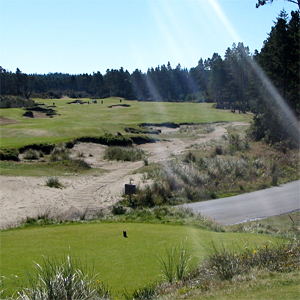
In the classic baseball movie Field of Dreams, Ray Kinsella (Kevin Costner) hears a voice whisper: "If you build it, they will come.” Following that advice, Bandon Dunes Golf Resort has built four of the Earth’s finest layouts -- Bandon Dunes, Pacific Dunes, Bandon Trails, and Old Macdonald -- in remote southern Oregon. Golfers now flock there to tee up.
Assume your golf attire, walk the courses, keep the ball low, and play the game as it was intended to be played.


No.4 St. Andrews - Scotland


With enticingly sinister bumps, knobs and hollows, the Old Course at St. Andrews is golfing gold heaven that gives players the thrill of lifetime. Every grate golfer in history has walked those hallowed fairways and, as a public course, you can too. Plus there are six other admirable links-style municipal courses in the Auld Grey Toon.
With the breeze from the North Sea, the spires of cathedrals serving as aiming points and footprints of golfing ghosts from centuries past, St. Andrews is the pinnacle of golfing heaven.

No.3 Celtic Manor Resort - Newport, Wales

Set in the verdant countryside of Wales is the majestic Twenty Ten course at Celtic Manor Resort. The host of the upcoming 2010 Ryder Cup features spectacular holes along the floor of picturesque Usk Valley.
Known as the "Gateway to Wales," the lovely landscape is dotted with trees that look as if they've been rooted through the ages. Peaceful lakes encroach on ripping fairways and dangerously sloped greens. Toss in the cheerful Welsh hospitality, incredible spa and the lavish comfort of the five-star resort, and you may never choose to leave.
While there, don't miss having drink in Merlins bar, just off the resort lobby. It's one of the world's best watering holes


No.2 PGA National Resort & Spa - Palm Beach Gardens, Florida 
With its storied golf history, which includes hosting the 1983 Ryder Cup, the 1987 PGA Championship, nearly two decades of the Senior PGA Championship, and now hosting the PGA Tour Honda Classic, PGA National’s Champion course is a jewel. The splendid Jack Nicklaus design boasts the infamous “Bear Trap,” one of the most difficult three-hole stretches in golf.
In addition to the famed Champion course, The Palmer, Haig, Squire, and Estates courses are all high-caliber and well worth a play. PGA National has the unique distinction of being the world;s only golf resort to feature both the David Leadbetter Golf Academy and Dave Pelz Scoring Game School.
And if all that wasn't enough, the spa is home to Waters of the World, a collection of pools featuring the world's rarest healing minerals.


No.1 Mission Hills Resort Shenzhen - Shenzhen, China

Is bigger better? With Mission Hills Resort Shenzhen, the answer is “definitely.” Stretching across the lush, rolling hills of Shenzhen and Dongguan in southern China, Mission Hills is China’s highest-rated golf club, and the largest golf club in the world, according toGuinness World Records.
With 12 exceptional courses designed by giants of the genre, like Jack Nicklaus, Greg Norman and Schmidt-Curley (probably the hottest international design company), it's time to tee it up on any layout at Mission Hills for an experience of Chinese golf heaven.
As an extra enticement, their spas are some of the best in the world.


Source: AskMen

Jumat, 03 Juni 2011

Interesting Facts about Top 10 things to do in Patagonia

Cerro Torre Los Glaciares National Park Patagonia Argentina
Coastal treasures, ancient forests, dazzling glaciers and incredible wildlife – Patagonia has captured your imagination, but where do you start? We have cherrypicked a few Patagonian delights from the latest Lonely Planet Argentina guidebook to get you started:

1. Whale-watch in Puerto Madryn

Patagonia offers some of the world's best whale-watching and Puerto Madryn is the place to glimpse them. The warm,  enclosed waters along the Golfo Nuevo, Golfo San José and the coastline near Caleta Valdés are prime breeding zones for southern right whales between June and mid-December. A standard whale-watching trip lasts an hour and a half, but longer excursions are available too.

2. Outdoor adventures in El Chaltén
El Chaltén's surrounding mountains are prime hiking, rock climbing and horseback riding territory so if you are into outdoor adventure, this is the spot for you. Think mountain traverses, mountain ascents and rock-climbing classes. You can go horse-riding to the pretty valley of Río de las Vueltas or take a more challenging ride up the Vizcacha hill followed by a barbecue on a traditional ranch. There are also ice-climbing courses and ice treks available.

Perito Moreno Glacier Patagonia Argentina
3. Dinosaur discovery at the Palaeontology Museum

Showcasing the most important fossil finds in Patagonia, this natural-history museum offers outstanding life-sized dinosaur exhibits and more than 1,700 fossil remains of plant and marine life. The three-hour guided visits are a walk through time, along a well-designed nature trail past a wealth of exposed fossils dating as far back as the Tertiary, some 40 million years ago. Speaking of dinosaurs...


4. Walk with the pre-historic
The Dinosaur route in northwest Patagonia is a wonderful adventure. The skeletons of the biggest dinosaurs ever to have walked the planet are, palaeontologists insist, buried in this region's red-rock badlands; and discoveries to date in the area have forced scientists to rethink established theories.


5. Penguin-watch at Punta Tombo

Punta Tombo has a colony of more than half a million Magellanic penguins and attracts many other birds, most notably king and rock cormorants, giant petrels and black oystercatchers. Most nesting areas in the 200-hectare reserve are fenced off: respect the limits and remember that penguins can inflict serious bites. Trelew-based travel agencies run day-long tours but may cancel if bad weather makes the unpaved roads impassable.


6. Explore Cueva de las Manos
The incredible rock art of Cueva de las Manos (Cave of the Hands) was proclaimed a Unesco World Heritage site in 1999. Dating from about 7,370 BC, these polychrome rock paintings cover recesses in the near-vertical walls with imprints of human hands, drawings of guanacos and, from a later period, abstract designs. Free guided walks are given every hour by knowledgeable staff. There is an information centre and a basic confitería, but it is best to bring your own food.

7. Stay at a ranch
Estancia Telken offers a welcoming stay in the pretty countryside of Los Antiguos. This 1915 working sheep and horse ranch 25km south of Perito Moreno has about 210 square kilometers of horseback riding and hiking possibilities, including a worthwhile meander along a creek bed up to the basalt plateau Meseta de Lago Buenos Aires.

8. Escape from it all in Camarones
Camarones takes home the gold for Patagonia's sleepiest coastal village. Empty beaches are perfect for strolling and the sociable townsfolk are masters of the art of shooting the breeze. It is also the closest hub to the lesser-known Cabo Dos Bahías nature reserve, where you can visit 25,000 penguin couples and their fuzzy chicks. The very helpful oceanfront tourist office offers maps, good tips on scenic outings and lodging information.

9. Watch glaciers at Parque National los Glaciares
Glaciar Perito Moreno is the stunning centrepiece of the southern sector of Parque Nacional Los Glaciares. Locally referred to as Glaciar Moreno, it measures 30km long, 5km wide and 60m high, but what makes it exceptional in the world of ice is its constant advance - it creeps forward up to 2m per day, causing building-sized icebergs to calve from its face. In some ways, watching the glacier is a very sedentary park experience, but it manages to nonetheless be thrilling. The main gateway town to the park's southern sector, El Calafate is 80km east of the glacier by road. This is where you will find all the operators for tours and activities too.

10. Dive into watersports
With interesting shipwrecks and sea life nearby, Madryn and the Península Valdés have become Argentina's diving capitals. Lobo Larsen and Scuba Duba are both quality PADI-affiliated operators and the former offers a special excursion for first-time divers. More into windsurfing or kayaking? In high season a hut next to Vernardino Club de Mar offers lessons and rents out regular and wide boards and kayaks by the hour. South of Muelle Piedrabuena, Playa Tomás Curti is a popular windsurfing spot.

Rabu, 01 Juni 2011

Interesting Facts About Mt Everest


Elevation: 29,035 feet (8,850 meters)
Location: Nepal/Tibet, Asia
First Ascent: Sir Edmund Hillary (New Zealand) and Tenzing Norgay (Nepal), May 29, 1953
Interesting Facts About Mt Everest:
Mount Everest is also called Chomolangma, meaning “Goddess Mother of Snows” in Tibetan and Sagarmatha, meaning "Mother of the Universe" in Nepalese. The mountain is sacred to the native people.
British surveyors named the peak for George Everest (properly pronounced “I-ver-ist”) a Surveyor General of India in the mid-nineteenth century.
Age: approximately 60 million years old.

Everest's current elevation is based on a GPS device implanted on the highest rock point under ice and snow in 1999 by an American expedition. The mountain is higher than 21 Empire State Buildings stacked on top of each other.
Mount Everest was once surveyed at exactly 29,000 feet but the surveyors didn't think people would believe that so they added two feet to its elevation, making it 29,002 feet.
Mount Everest is rising from 3 to 6 millimeters or about 1/3 inch a year. Everest is also moving northeastward about 3 inches a year.
Mount Everest was dissected by glaciers into a huge pyramid with three faces and three major ridges on the north, south, and west sides of the mountain. Five major glaciers continue to chisel Mount Everest—Kangshung Glacier on the east; East Rongbuk Glacier on the northeast; Rongbuk Glacier on the north; and Khumbu Glacier on the west and southwest.
Mount Everest has an extreme climate. The summit temperature never rises above freezing or 32° F (0° C). Its summit temperatures in January average -33° F (-36° C) and can drop to -76° F (-60° C). In July, the average summit temperature is -2° F (-19° C).
The best time to climb Everest is in early May before the monsoon season.
The Southeast Ridge from Nepal, called the South Col Route, and the Northeast Ridge or the North Col Route from Tibet are the usual climbing routes.
In 1978 Reinhold Messner and Peter Habeler were the first to climb Mount Everest without supplemental oxygen. Messner later described his summit experience: "In my state of spiritual abstraction, I no longer belong to myself and to my eyesight. I am nothing more than a single narrow gasping lung, floating over the mists and summits." In 1980 Messner made the first solo ascent, which was via a new route on the mountain's north side.
The largest expedition to climb Mount Everest was a 410-climber Chinese team in 1975.
The most climbers to reach the summit in a single day was 40 on May 10, 1993.
The safest year on Mount Everest was 1993 when 129 climbers reached the summit and only 8 died.
The least safe year on Mount Everest was 1996 when 98 climbers summitted and 15 died. That season was the Into Thin Air fiasco documented by author Jon Krakauer
Sherpa Babu Chiri stayed on the summit of Everest for 21 hours and 30 minutes.
Stacey Allison from Portland, Oregon made the first ascent by an American woman on September 29, 1988.
The country with the most deaths on Mount Everest is Nepal with 47 (as of 2009).
Jean-Marc Boivin of France made the fastest descent from the summit of Mount Everest to the base by swiftly paragliding down in 11 minutes.
Davo Kamicar of Slovenia made the first ski descent of Mount Everest on October 10, 2000.
Over 150 bodies of dead climbers are on the peak.
A jumping spider lives up to 22,000 feet on Mount Everest.
A helicopter piloted by a Frenchman supposedly made a hover landing on the summit in 2005.
New World Record has been set by Apa Sherpa from Nepal. He climbed Mt. Everest 21 times till date i.e. June 2011.
Notable dates: 
1921 — Dalai Lama allows British reconnaissance party to visit Tibet and the northern side of Mt. Everest. 
1924 — British explorers George Mallory and Andrew Irvine disappear near the summit, along the Northeast Ridge. It is possible that they may have actually been the first to reach the summit, but they never returned.
1949 — Nepal opens its borders, making access to the mountain's southern peak possible.
1953 — Hillary and Norgay reach summit.
1963 — First Americans reach the summit.
1989 — First two women, both American, reach the summit.
1990 — Sir Edmund Hillary's son, Peter, reaches summit.
1996 — Eleven people die during spring expeditions.

Kamis, 19 Mei 2011

Best Android Phones in the Market as of Now

We compare five of the best Android phones on the market today, including the HTC Thunderbolt 4G, Motorola Atrix 4G, and HTC Inspire 4G.
The world of Android is fast and furious (maybe too fast and too furious). We made a Best Android handsets list six months ago, but it’s already woefully outdated. Our late 2010 picks were the Motorola Droid X, HTC EVO 4G, HTC Droid Incredible, T-Mobile G2, and Samsung Captivate. While these are all still excellent Android devices, time marches on, and so do our picks. Below are five of our favorite Android handsets currently on the market.

HTC Inspire 4G

The Inspire may not have the fancy dual-core processor that some of the newest Android phones have, but it’s a great device at a great price. We’re big fans of HTC’s Sense user interface (UI), which may be the best Android user interface on the market, especially for new users. If this is your first smartphone and you’re on AT&T, the 4.3-inch phone is a great choice. For those wondering, the Inspire 4G has 4GB of internal storage, an 800MHz TI OMAP 3610 processor, 4G HSPA+ support, and a 480 x 800 pixel display. It has a few shortcomings, however. It lacks a front-facing camera and the battery cover is oddly placed and difficult to remove. We are also still waiting for an upgrade to Android 2.3, which HTC says will come soon.


Motorola Atrix 4G

Motorola made a big splash with its series of Droid phones on Verizon, but its flagship AT&T phone has had a rough time catching on with consumers, likely because of its far-too-expensive laptop dock attachment. We’re honestly not sure what Motorola was thinking when it released the $500 peripheral with theAtrix 4G. Remove the dock from the equation though, and the Atrix 4G is one of the best phones on the market today with a 1GHz dual-core Nvidia Tegra 2 processor, 1GB of RAM, 16GB of internal storage, a 540 x 960 qHD 4.0-inch screen, 4G HSPA+ support, and a built-in biometric fingerprint reader. The only downside to the handset is that it uses the MotoBlur UI, which just doesn’t hold up well compared to the modified UI by HTC and other manufacturers.


T-Mobile G2x

The T-Mobile G2x is actually an LG Optimus phone, and shows that LG is beginning to lead the pack with its high-end Android devices. We don’t have a full review out yet, but we got the chance to spend some time with this phone at CTIA in late March and walked away highly impressed. Though it has a 1GHz dual-core processor, its specs don’t quite match up to the Atrix, but hey, it’s probably the best phone on T-Mobile right now, and fast enough to satisfy the most demanding of users. We also like that LG tends to leave Android alone, for the most part. Unlike Motorola, which seems to tamper just for the sake of tampering, the Android UI changes in LG’s newer phones are minimally invasive and seem to make sense. We can’t complain about the HDMI mirroring either. This is a device worth switching carriers for, if T-Mobile coverage is good in your area. The carrier also has some of the best data rates.


HTC ThunderBolt 4GHTC ThunderBolt 4G

If you’re willing to live on the cutting edge, the Verizon HTC ThunderBolt is a good choice for you. This is the first phone that can tap into the carrier’s next-generation 4G LTE network, which is up and running in many cities across the United States. Obviously, you’ll want to check your local coverage, but give it a spin if it’s available. There are downsides to living on the bleeding edge, however. Verizon’s 4G network has had a few hiccups and ThunderBolt users have complained of shorter-than-average battery life for the handset. Still, it could be worse, and Verizon’s network is poised to have the best actual 4G coverage for some time to come, as AT&T’s LTE network is still in early testing.


Google Nexus S 4G


Sprint’s EVO line of phones is great and we’re looking forward toSamsung’s Galaxy S II, but for now, the Google Nexus S, made by Samsung, is a great option for those who’d like a full-featured Android phone on Sprint. Co-designed by Google to deliver a pure Android experience, the Nexus S is just about the only handset currently on the market that has Android 2.3 (Gingerbread). The update adds some graphical enhancements to Android and needed upgrades to core features like battery management. Better yet, the Nexus S is equipped with Sprint WiMax 4G capabilities. While not as fast as Verizon’s LTE network, WiMax is an actual 4G technology whereas T-Mobile and AT&Ts’ HSPA+ networks are more like 3G networks on steroids. Another perk of having a Google phone is that you may actually get the next version of Android when it comes out, not six to 12 months later, as seems to be the norm these days.
Source: Yahoo Shopping